








OTA Testing: The Key to Ensuring Wireless Connection Quality for Your Device
Do you know why some IoT devices operate smoothly in every corner of the house, while others are unstable and lose connection just a few meters away from the router?
For manufacturers of electrical and electronic products, skipping or inadequately performing OTA testing can lead to serious consequences: defective products reaching the market, costly recalls, and—worse yet—a loss of customer trust.
So, what does the process entail, and why should businesses turn to professional OTA testing services?
What is OTA testing?
OTA (Over-The-Air) testing is a method used to measure and evaluate the radio frequency (RF) transmission and reception performance of a wireless device in a real-world environment, without requiring a direct physical connection via cables (as in conducted testing).
Unlike traditional measurement methods that assess antennas or RF circuits in isolation, this testing evaluates the entire device system—including the antenna, casing, internal components, and even how the user holds the device—as a complete whole.
In other words, OTA testing accurately simulates how the device will perform once it reaches the consumer, enabling manufacturers to detect issues regarding coverage, signal reception sensitivity, or transmission power early on—problems that other measurement methods might fail to identify.
Why is OTA testing important for electronics manufacturers?
Ensuring a real-world user experience
Consumers do not care about technical specifications on paper; they only care about whether the device maintains a stable connection, streams video smoothly, and handles calls without dropping the signal.
This is the only way to verify this before the product is launched on the market.
Meeting Certification and Regulatory Requirements
Major markets such as the US, Europe, and Japan require wireless devices (phones, IoT devices, routers, wireless medical equipment, etc.) to pass OTA tests based on CTIA, 3GPP, or ETSI standards before market authorization is granted.
Without this certification, it is virtually impossible to legally export the product.
Optimizing Costs and Accelerating Time-to-Market
Detecting antenna design flaws or RF performance issues during the development phase helps businesses avoid costly post-production fixes while accelerating the product’s time-to-market.
Enhancing Brand Reputation
Products that undergo rigorous OTA testing demonstrate a company’s commitment to quality, creating a distinct competitive advantage over rivals that rely solely on basic testing.
Key Metrics in OTA Testing
TRP (Total Radiated Power): The total power radiated by the device in all directions, reflecting its transmission capability.
TIS (Total Isotropic Sensitivity): Overall receiver sensitivity, indicating the ability to capture weak signals.
EIRP (Effective Isotropic Radiated Power): Effective radiated power in a specific direction.
OTA Throughput: Actual data transmission speed over the wireless link under various conditions.
Antenna Efficiency: The operational efficiency of the antenna integrated into the device.
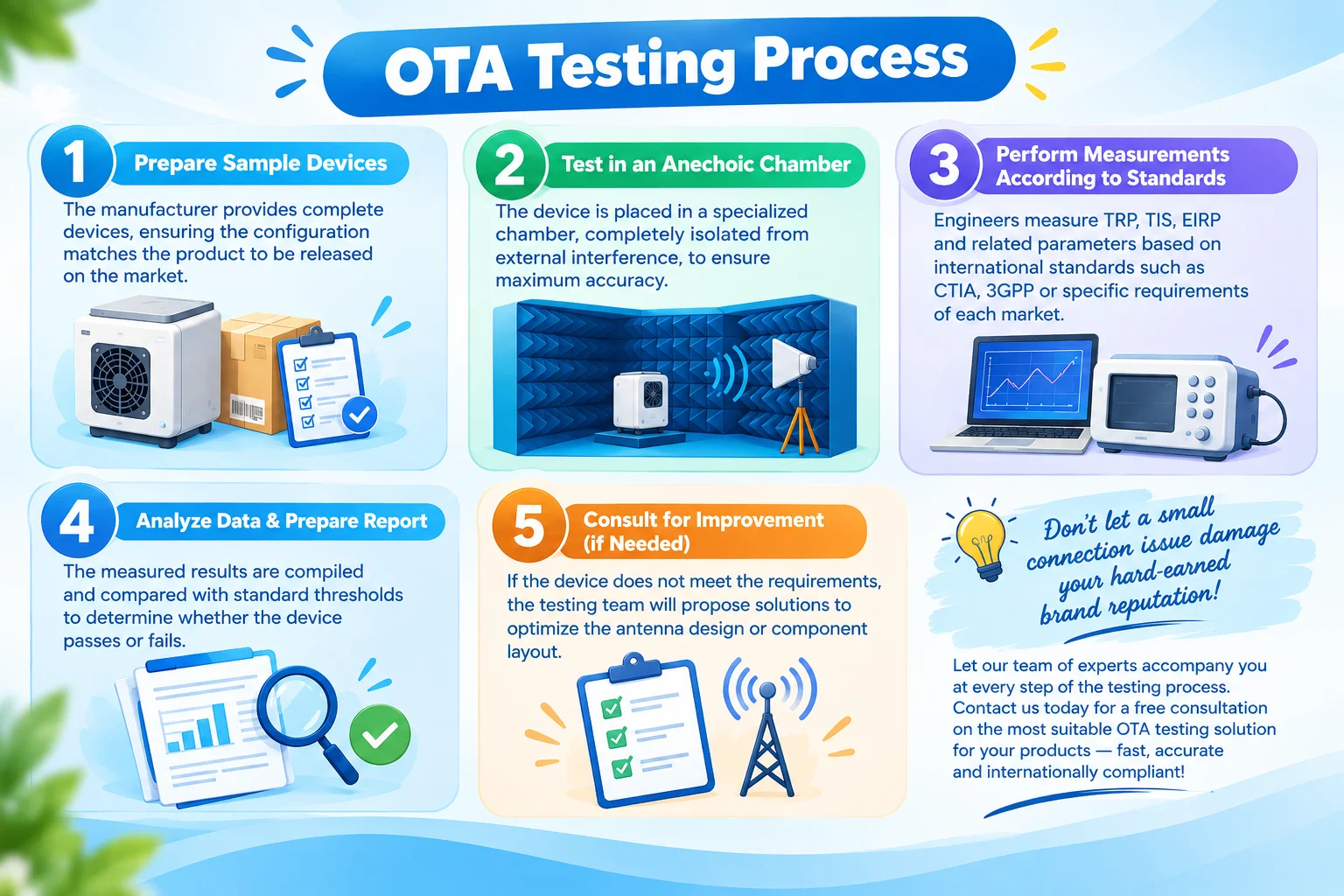
OTA Testing Process