










Machinery Regulation (EU) 2023/1230: Five key changes businesses should prepare for before 2027
Machinery Regulation (EU) 2023/1230: Five Key Changes Businesses Should Prepare for Before 2027
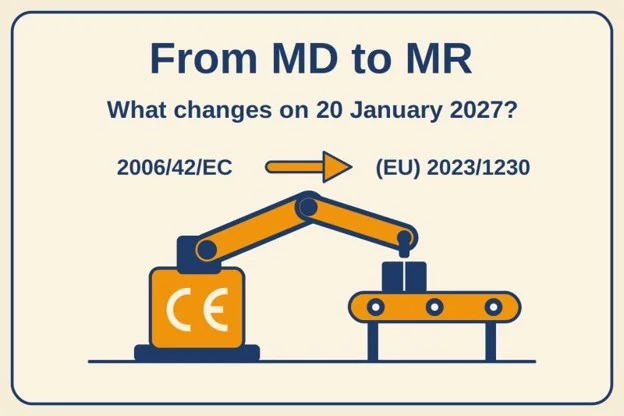
On 20 January 2027, the Machinery Regulation (EU) 2023/1230 will officially replace the Machinery Directive 2006/42/EC, introducing a new regulatory framework for machinery placed on the European Union (EU) market.
Unlike the current Directive, the new Regulation will apply directly across all EU Member States without requiring national transposition. It also introduces several significant changes relating to machinery safety, cybersecurity, technical documentation, and conformity assessment.
For manufacturers, importers, and exporters supplying machinery to the European market, understanding these changes and preparing in advance will be essential to maintaining compliance and ensuring uninterrupted market access.
1. A Regulation Replaces the Machinery Directive
The most fundamental change is the replacement of the Machinery Directive 2006/42/EC with the Machinery Regulation (EU) 2023/1230.
Unlike a Directive, which requires each Member State to implement it through national legislation, a Regulation applies directly and uniformly throughout the European Union. This creates greater legal consistency and reduces differences in implementation across Member States.
For manufacturers, this means a more harmonized regulatory framework and greater legal certainty when placing machinery on the EU market.
2. Digital Instructions Become an Accepted Option
The new Regulation officially allows manufacturers to provide operating instructions in digital format, reflecting the increasing digitalization of industrial products and documentation.
However, several important conditions must still be met:
– Digital instructions must remain easily accessible throughout the product’s lifecycle.
– A printed copy must be supplied upon request.
– Safety information for machinery intended for non-professional users must continue to be provided in paper format.
This change offers businesses greater flexibility while reducing printing costs and simplifying document updates.
3. Cybersecurity Becomes an Essential Safety Requirement
One of the most notable additions to the new Regulation is the integration of cybersecurity into machinery safety requirements.
Under Annex III, safety-related control systems must be protected against unauthorized or malicious external interference. As machinery becomes increasingly connected through software, industrial networks, and the Internet of Things (IoT), cybersecurity is now recognized as a critical element of product safety.
This requirement is particularly relevant for:
– Industrial robots
– Automated production systems
– Smart manufacturing equipment
– Network-connected machinery
– Software-controlled machines
Manufacturers should review both hardware and software designs to ensure that cybersecurity risks do not compromise the safe operation of machinery.
4. “Substantial Modification” Is Clearly Defined
4. “Substantial Modification” Is Clearly Defined
For the first time, the Regulation introduces a harmonized EU-wide definition of Substantial Modification.
Where a person or organization significantly modifies machinery in a way that affects its safety or intended function, they may legally become the new manufacturer of that machinery.
As a result, they assume all corresponding legal obligations, including:
– Conducting a conformity assessment;
– Preparing technical documentation;
– Issuing an EU Declaration of Conformity;
– Affixing the CE marking before placing the modified machinery on the market.
This clarification removes a long-standing legal grey area and provides greater certainty for companies involved in machinery refurbishment, modernization, or retrofitting.
5. High-Risk Machinery Will Require Mandatory Third-Party Assessment
For machinery listed in Annex I, Part A, manufacturers will no longer be permitted to rely solely on self-assessment.
Instead, conformity assessment must involve a Notified Body, ensuring an independent evaluation before the machinery can be placed on the EU market.
Businesses should determine as early as possible whether their products fall within these high-risk categories so they can allocate sufficient time for testing, certification, and regulatory approval.
What About the UK Market?
Although Great Britain is no longer part of the European Union, it continues to recognize the CE marking for many categories of machinery.
In many cases, an assessment carried out by an EU Notified Body remains acceptable for the Great Britain market.
A UK Approved Body is generally required only when manufacturers choose to follow the UKCA conformity assessment route.
How Should Businesses Prepare?
How Should Businesses Prepare?
With the Regulation becoming fully applicable on 20 January 2027, companies should begin preparations well in advance by:
– Reviewing products currently certified under Machinery Directive 2006/42/EC;
– Performing a gap analysis against the requirements of Machinery Regulation (EU) 2023/1230;
– Updating technical documentation and user instructions;
– Evaluating cybersecurity measures for connected machinery;
– Identifying products subject to mandatory Notified Body involvement;
– Planning conformity assessment and CE certification activities before the Regulation takes effect.
Early preparation will help minimize compliance risks, avoid delays in market access, and ensure a smooth transition to the new regulatory framework.
Conclusion
The Machinery Regulation (EU) 2023/1230 represents far more than a legislative update. It reflects the European Union’s evolving approach to machinery safety by introducing stronger cybersecurity requirements, greater legal clarity, and more robust conformity assessment procedures.
Manufacturers and exporters that begin preparing today will be better positioned to maintain compliance, reduce regulatory risks, and continue accessing the European market without disruption.
If your company requires support with product testing, conformity assessment, CE marking, or regulatory compliance under Machinery Regulation (EU) 2023/1230, the experts at Interlink are ready to help you navigate the entire certification process efficiently and confidently.
Reference
Regulation (EU) 2023/1230 of the European Parliament and of the Council on machinery: https://eur-lex.europa.eu/eli/reg/2023/1230/oj/eng